Onegin’s belated, unrequited love for Tatyana
Eugene OneginOnegin’s belated, unrequited love for Tatyana is a reversal that arrives too late to repair their earlier estrangement: he now longs for the woman whose love he once failed to answer, while she remains beyond his reach. The poem renders this reversal as both emotional fixation and bodily decline, then carries it to a final appeal in which Onegin places his fate in Tatyana’s hands. His love becomes a decisive force in the ending, but not a promise of mutual fulfillment.
From rejection to belated longing
The change is emphatic: Tatyana’s love is described as enduring, and now Onegin, in turn, is said to love as he did when he was young. The feeling governs his days and nights. Instead of the freedom he once maintained from attachment, he is caught in sad, love-lorn meditation; longing has become the organizing condition of his life.
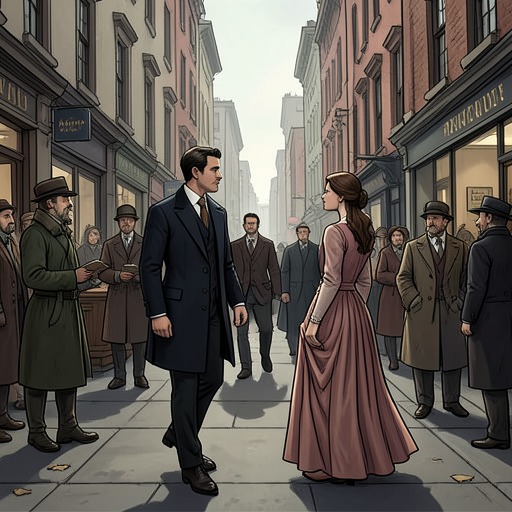
The reversal does not erase what came before. Its poignancy lies in the changed timing: Onegin’s devotion emerges after Tatyana has become inaccessible to him, so the love that might once have joined them now deepens their separation. The available account establishes the mismatch and its cost, rather than presenting his belated feeling as a successful recovery of their earlier possibility.
A love made visible in decline
Onegin’s suffering is not confined to inward reflection. His cheek grows ashy pale, and the narrator says that he wastes away and is already becoming consumptive. The concrete signs make his private attachment legible to others, even as Tatyana either does not see them or ignores them. That uncertainty matters: the narrative does not establish whether she fails to notice his condition or chooses not to respond.
His decline is severe enough that he sends for doctors, who recommend the waters. The advice gives his lovesickness a practical consequence and places it in a recognizable course of illness and treatment; it does not, in the evidence available here, resolve the emotional cause. The contrast between medical intervention and unreturned desire sharpens the limits of what can be remedied: Onegin can be directed toward the waters, but his attachment remains fixed on Tatyana.
Pursuit and appeal
At the close, the longing becomes action. Onegin gallops to Tatyana’s house, enters, and is described as ghastly white. His arrival carries the love plot into a decisive encounter: the man who once stood apart now comes urgently to the woman he calls his own, though that possessive phrasing does not establish that she belongs to him or shares his feeling.
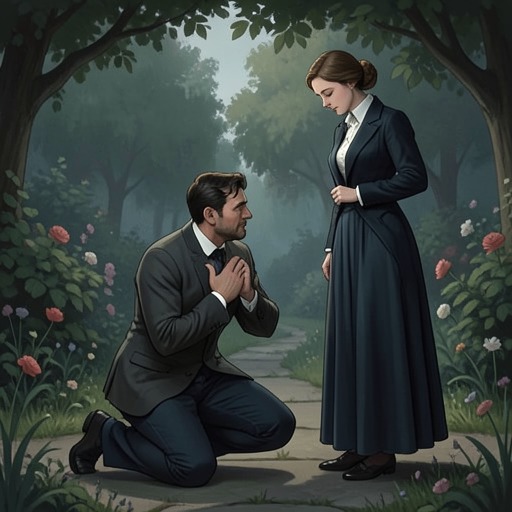
Tortured by wild regret, Onegin falls at Tatyana’s feet. The gesture marks a reversal in his position: he is no longer the composed figure who could refuse her declaration, but a supplicant exposed before her. Tatyana starts and says nothing; she gazes at his face. Her silence and gaze register the encounter without confirming acceptance, forgiveness, or reciprocal love.
Surrender without resolution
Onegin’s earlier imagined happiness is defined by continued access to Tatyana: seeing her face, following her, and keeping her image in his soul. He calls such proximity true felicity, yet recognizes that it is not for him. His daily solitude is therefore not a temporary pause before fulfillment, but the condition in which his love persists without the relationship he desires.
The final language of surrender intensifies rather than settles that impasse. Onegin says that he can no longer wage a concealed struggle, declares that the die is cast, and yields his life and fate into Tatyana’s hands. The declaration makes his dependence explicit, but it does not disclose what Tatyana will decide. The ending leaves his love at the threshold between confession and consequence: he has reversed his former refusal, but the evidence ends with her silent attention, not with reconciliation.
Narrative significance
The attachment gives the poem a sharp temporal irony. Onegin’s capacity to suffer for Tatyana becomes visible only after the earlier opportunity has passed; the man who could not answer her love now experiences longing as daily fixation, social disregard, and illness. The reversal gives his emotional change weight without treating intensity as a guarantee of reward.
The closing scene also places the decision outside Onegin. His fall at Tatyana’s feet and surrender of his fate make his appeal unmistakable, while her silence withholds the response that could turn his private passion into a shared future. His love is thus decisive not because it resolves the relationship, but because it exposes the distance between belated recognition and the other person’s choice.